|
|
|
 |
Advanced Aerodynamics and Hydrodynamics for Powerboats |
| Performance Boat design and setup secrets for Recreational tunnels, Offshore Cats, Racing tunnels, Fishing/Utility hulls, Vee and Vee-Pad Hulls, Bass Boats | |
| Home New About Us Free Articles Technical Articles TBPNews Archives FREE Downloads Research Contact Us | |
Testimonials
What Others Say
Join TBPNews
Advertise
Search
Buy Now

  
|
|
| TBDP©/VBDP© Porpoise Regime Analysis | ||
| Get complete article by email request: | Share: | |
| BREAKTHROUGH! | ||
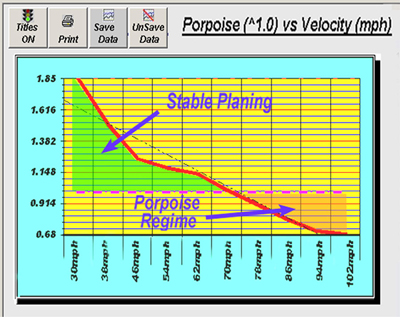 Figure 1- TBDP©/VBDP© graphic output shows the velocity at which your hull configuration experiences instability in Porpoise Regime and susceptibility to porpoising. |
Porpoising can affect any performance
hull design, but when will it happen? under what conditions?
how do we fix it? We have developed a new analysis tool in the TBDP©/VBDP© software! XPorpoise is an engineering tool developed by AR® that helps predict your hull's inherent instabilities leading to porpoising. The technique is based on a uniquely modified Stavitsky & Day/Haag method of hydrodynamic prediction of the critical porpoise trim angle (CPA) for various hull/setup configurations, velocities and Lift characteristics. Porpoising onset occurs when the lift is generated at a sufficiently high trim angle or sufficiently low deadrise so as to cause a dynamically unstable loading on the lifting surfaces. By analysis of a hull's design and performance characteristics and comparison to the CPA for each velocity in performance range, TBDP©/VBDP© can predict when the hull is susceptible to porpoising and when it is performing in a stable regime. Highly accurate for variable deadrise, multiple lifting surfaces, and imbalanced surface loadings. Alternative design comparison helps optimize performance and minimize or eliminate porposing tendancies. |
|
|
Establishing the critical porpoising limits is more complicated when we must include the interaction of sponsons (tunnel hull) or vee surfaces (vee hull) with a centerpod or vee-pad hull configuration. Porpoising analysis is particularly complex when dealing with stepped hulls. TBDP© and VBDP© now analyzes the influence of complex stepped hulls on the onset of porpoising for tunnel hull, vee hull, centerpod, and vee-pad hulls.
|
||
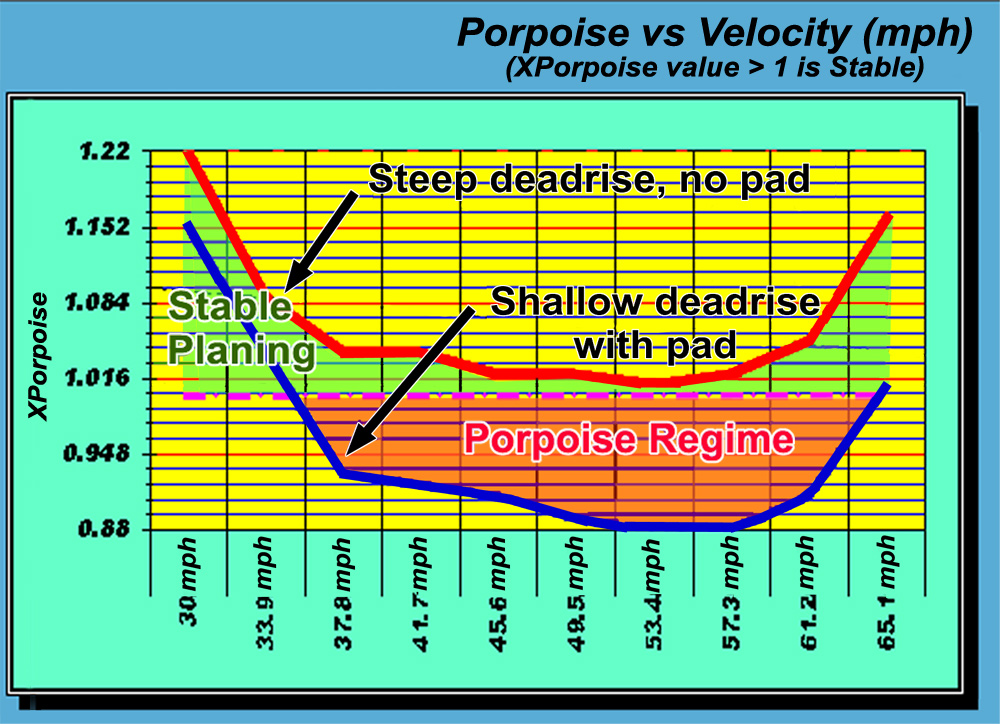 Figure 2 - VBDP© graphic output shows the differences in vee hull bottom designs that can contribute to instability in Porpoise Regime and susceptibility to porpoising. |
TBDP©/VBDP© analyzes the porpoising stability of your hull design/setup throughout the entire operating velocity range. TBDP©/VBDP© then presents the analysis for your design for operation in "stable planing regime" or "Porpoise instability regime". When your hull is in the "stable planing range", the hull is less likely to experience porpoising. When your hull is in the "Porpoise instability regime", it is susceptible to porpoising. The ability for TBDP©/VBDP© to present graphic view of XPorpoise analysis throughout the full operating velocity range, for TWO design alternatives simultaneously, makes comparative evaluation quite easy. (Note view in Figure 2 that shows "shallow deadrise with pad" vee hull, compared to "steep deadrise, no pad" vee hull designs - and their relative susceptibility to porpoising in "Stable Planing" regime (less susceptible to porpoising) or "Porpoise Regime" (more susceptible to porpoising). |
|
|
TBDP©/VBDP© and the XPorpoise analysis can identify the susceptibility of your hull to porpoise and show what speeds that it will occur. So, what can I do about it? Porpoising is a function of the lift generated by your hull, the deadrise of your running surfaces, and the trim angle that is needed to get that lift. If the hull design/setup is 'prone to porpoising', the onset of porpoising will start at a velocity that triggers a change in dynamic center of gravity (often the hump zone). The resolution to a porpoising problem with a hull design is most always addressed by causing the boat to run with less trim. If a boat is porpoising at a given speed and load, lowering the trim angle will reduce or eliminate the porpoising. There are several ways to get there, but the bottom line is to reduce the trim angle at the velocity of porpoising onset. Even if the hull design is operating in the "Porpoising Regime" through a full range of velocities, reducing trim in some way will improve or resolve the problem. Resolutions to an existing porpoising problem: -Reduce Trim Angle -Change Static Weight Locations -Change Dynamic Forces location -Clean up Hull bottom condition -Optimize Propeller Selection -Design with Higher Deadrise (bottom surfaces) -Trim Tabs Porpoising Analysis Sensitivity: 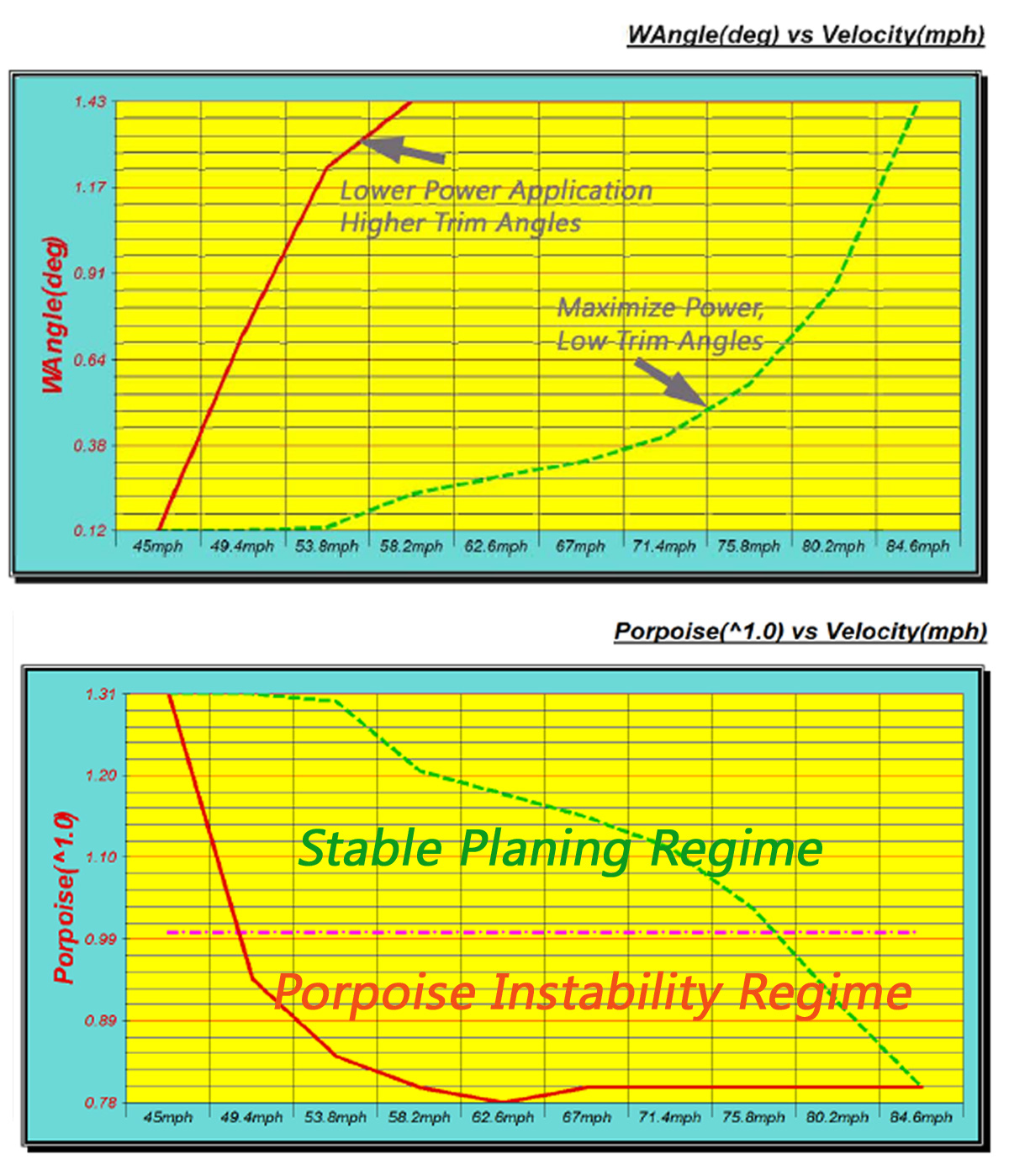 Some boat designs and
setups are quite sensitive to trim angle, as it applies to
the susceptibility to porspoising onset. When a hull is set up to be
able to utilize full power, then sufficiently low trim angles
can be achieved and the hull can operate in ‘stable planing
range’. Some boat designs and
setups are quite sensitive to trim angle, as it applies to
the susceptibility to porspoising onset. When a hull is set up to be
able to utilize full power, then sufficiently low trim angles
can be achieved and the hull can operate in ‘stable planing
range’. It is important to note that in operation, you may have the boat set to run at lower power levels and different trim angles during some parts of your speed range. If setup is unable to take advantage of full power for some reason (driving, propeller selection, engine height, engine trim settings, etc), then higher trim angles can move the hull into ‘Porpoise instability regime'. You can illustrate this with TBDP©/VBDP© by testing with varying trim angle settings, to view resulting porpoising results and hence, the sensitivity of the boat to trim angle settings as it affects the onset of porpoising. this 'sensitivity' analysis is a good design approach with hull designs that are likely to be more sensitive to trim angle (eg: lower deadrise planing surfaces or higher trim angle operating requirements). PORPOISING
ANALYSIS VIDEO |
||
Research results now included in performance analysis by TBDP©/VBDP© [more about AR's research more about AR's publications and technical articles/papers] |
||
|
© Copyright 2017 by
Jim Russell and AeroMarine Research® - all rights reserved. Material from this website may not be copied or used or redistributed, in whole or in part, without the specific written consent of Jim Russell or AeroMarine Research. |
||