
~~~~~~~~~~~~~~~~~~~~~~~~~~~~~~~~~~~~~~~~~~~~~~~~~~~~~~~~
TBPNews #118 – March 22, 2008
~~~~~~~~~~~~~~~~~~~~~~~~~~~~~~~~~~~~~~~~~~~~~~~~~~~~~~~~
>>>> Tunnel Boat Performance News
>>>>>> (over 5000
members!)
========================================================
In this issue:
1) St. Louis Grand Prix Powerboat Races
ready for 37th Annual Event
2) FEATURE ARTICLE - "What a Blowout!"
3) OSS Back in
Full Force
4) 2008
World Class 1 season starts up in Qatar
5) Evinrude Multi-Fuel Engines
Available for Consumers
6) NEW Powerboat History & Design
Books On-line
7)
2007 AeroMarine Research®
Software Update
8) Powerboat Racing on TV
9) Jimboat's NEW Feature Articles
******************** TBPNews
*******************
1) St.
Louis Grand Prix Powerboat Races ready for 37th Annual Event
 The
St. Louis Grand Prix Powerboat Races, presented by BUD LIGHT, have finalized the
date for 2008. The races will be held on August 2nd and 3rd, 2008, at Creve
Coeur Lake.
The
St. Louis Grand Prix Powerboat Races, presented by BUD LIGHT, have finalized the
date for 2008. The races will be held on August 2nd and 3rd, 2008, at Creve
Coeur Lake.
BUD LIGHT will not only be the title sponsor, they have renewed their sponsorship of Seebold Racing and driver Tim Seebold for the 27th year. Mercury Marine will be supporting the event as well. This will be the 37th year that the Concord Village Lions Club has organized the event. Missouri Sports Hall of Fame and Motorsports Hall of Fame of America member, Bill Seebold is the Chairman of the event.
The 37th annual St. Louis Grand Prix Powerboat Races will feature drivers from all over the USA, and internationally. Classes participating will be the CHAMP Boats, also known as F1CHAMP, the CHAMP2 or SST 120’s, and the CHAMP3 or SST 45’s.
check out more at:
www.stlgrandprix.net and
www.champboat.com.
******************* TBPNews
*******************
2) FEATURE ARTICLE: "What a Blowout!"
We receive many questions about the cause and
effects of "blow-out". Here is an explanation of Blowout and causes...
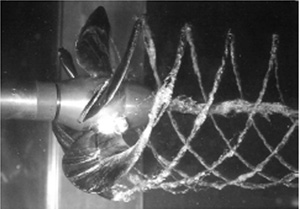 Blowout
occurs when something causes air/water mixture in the region of the propeller to
become sufficiently disturbed that the propeller cannot continue working in
“clean” water, but is rather, trying to work through a very soft or light
mixture (or a relative vacuum). This causes the propeller efficiency to
significantly fall off, (seems to lose thrust) and triggers a typically dramatic
hull performance behaviour. These behaviors can vary from a feeling of "loose"
steering to a nasty turn (typically to the right). The velocity at which
“blowout” takes place depends on boat design, hull setup, lower unit design,
propeller design, and driving style.
Blowout
occurs when something causes air/water mixture in the region of the propeller to
become sufficiently disturbed that the propeller cannot continue working in
“clean” water, but is rather, trying to work through a very soft or light
mixture (or a relative vacuum). This causes the propeller efficiency to
significantly fall off, (seems to lose thrust) and triggers a typically dramatic
hull performance behaviour. These behaviors can vary from a feeling of "loose"
steering to a nasty turn (typically to the right). The velocity at which
“blowout” takes place depends on boat design, hull setup, lower unit design,
propeller design, and driving style.
The main contributors to blowout are:
• Motor height:
If the engine is positioned too high, the propeller may not generate sufficient
lift for the boat. This usually requires that the driver then apply excessive
trim (out). This causes the direction of thrust of the propeller (shaft) to be
less than optimum - inclined downward instead of aligned exactly in the
direction of motion (parallel to the water surface). This trim angle is thus
forcing an inefficient profile to the hydrodynamic flow around the lower unit
(more drag) and the propeller (inefficient lift). Designing the hull and the
boat setup with the engine at the optimum height will help overall performance.
Using a jack plate will make these engine adjustments much easier. This is easiest to do with a hydraulic jack plate, but a manual jack plate will provide the same range of adjustment needed. [Remember that as you raise the engine height, a low water pickup may become necessary in order to ensure that the engine gets enough water pressure.] Often, as the engine is raised on the transom, the reduced lower unit drag can allow for a different trim angle to be applied, resulting in an improved effect on the speed of "onset of blowout”.
• Gear case condition:
If the gear case has been damaged (tagged any logs or rocks lately?); or has an
improperly installed nosecone; or a damaged skeg; the gear case cannot maintain
the intended hydrodynamic direction (steering). The impact can be the desire
(need) for the gear case to "crab" through the water, creating an area void of
pure water, like an air pocket where the propeller is now trying to perform its
duty. This is bad news for the propeller - it needs water to work properly.
Cleaning up all the scratches, scrapes, nicks and gouges in the gear case so
that it is very smooth will improve performance. Don’t underestimate the
possible significance of this operation – the smallest and seemingly trivial
defects in the gear case surfaces can trip the “onset of blowout”!
• Hull Design:
Some hull designs are more susceptible to "blowout" than others. There are no
“rules” for how to design for “no blowout”, since there are so many operating
and performance issues that the designer must consider. It’s difficult to merely
“look” at your boat to determine whether it might be susceptible to “premature
onset of blowout” or not. The well-designed hull will have a dynamically
balanced performance through all operating speeds. The inherently unstable
hull will need more effort with "on the water" set-up. Weight distribution,
engine positioning, bottom cleanliness are some features that can be altered, if
need be, after the boat is diagnosed with problems. The hull that is dynamically
stable throughout its uppermost velocity range can reduce the tendency for
blowout and lessen the otherwise dramatic effects of blowout.
• Velocity:
Once a stock gear case is asked to go faster than it's original design speed,
water separates from the leading edge of the bullet and upsets the flow around
the propeller. In engineering terms, this is a disturbed flow, and when this
occurs near the propeller, it really impacts the propeller's performance and
efficiency. Smaller gear cases with smaller, aerodynamic bullets will always
improve this situation, delaying "blowout" tendencies to a higher velocity.
Adding a nosecone can also increase the velocity (delay the onset of blowout)
that a standard gear case can operate effectively (more on nosecones later).
The cause of blowout is generally a combination of all of these sources. Gear case modifications and propeller changes can reduce your chance of blowout or reduce the tendencies for blowout, or delay the onset of blowout (velocity). A properly designed and dynamically balanced hull also helps the blowout situation. The reality of high performance powerboating is, however, that as you strive for the maximum performance of your setup, blowout is often just piece of the business, so you will experience it eventually.
• Nose-cone technology - As water flows by
the lower unit and begins to separate from the unit at higher speeds, a
turbulent flow
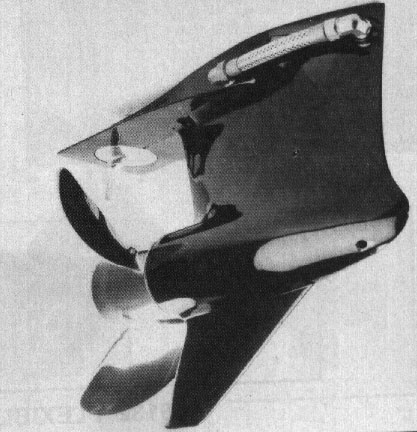 condition
or "vortex" causes a lower pressure behind the gear case. This lower pressure
increases the drag of the lower unit. A by-product of the air/water mixture and
the water separation from the gearcase surfaces is propeller burning. This
phenomenon leads to blow-out, and can also reduce top speed before blow-out is
obtained. By increasing the length of the “bullet” on the lower unit, the
hydrodynamic aspect ratio (length to diameter ratio) of the bullet is increased
(improved), providing superior water flow characteristics and delaying the onset
of propeller burn and blowout. A well-designed nose cone can delay the speed at
which blow-out occurs and improve propeller efficiency.
condition
or "vortex" causes a lower pressure behind the gear case. This lower pressure
increases the drag of the lower unit. A by-product of the air/water mixture and
the water separation from the gearcase surfaces is propeller burning. This
phenomenon leads to blow-out, and can also reduce top speed before blow-out is
obtained. By increasing the length of the “bullet” on the lower unit, the
hydrodynamic aspect ratio (length to diameter ratio) of the bullet is increased
(improved), providing superior water flow characteristics and delaying the onset
of propeller burn and blowout. A well-designed nose cone can delay the speed at
which blow-out occurs and improve propeller efficiency.
Cavitation is not Blowout….but we always get it! Cavitation is “the sudden formation and collapse of low-pressure bubbles in liquids in regions of very low pressure or regions that are subjected to rapid or intense pressure changes”.
The design of a gearcase is a compromise
hydrodynamically. Irregularities on the outside surfaces of the gearcase
such as fill holes, drain holes, water vents, etc. create a disturbance of the
flow and can cause cavitation as the speed of the boat increases.
You might not even have "Blowout" - Very few boats run into a "total"
blow-out situation...more often the setups encounter "propeller burn" - a
phenomenon that occurs prior to blow-out. Many high performance boaters may be
experience propeller burn and not even be aware of it. You may have noticed
pitting on your propeller blades caused by this propeller burn. The addition of
a nose cone can reduce or even eliminate propeller burn, blow-out, and allow you
to improve your speed if the horsepower is available.
When blowout does occur, the propeller breaks loose completely and cannot recover until the boat is slowed down enough to allow water to re-enter the propeller void created by the ventilation occurrence.
Blowout can sneak up on you! - Classically, just prior to encountering a blowout you will experience a "loose" steering feeling, an RPM increase without any speed increase, a loss of lift, and a resulting drop of the bow of the boat. When all of these happen quickly, it can be a hair-raising incident! With experience, you can learn to sense when you are approaching the onset of “blowout”…so pay close attention, take appropriate actions, always wear your PFD…and hold on!
See more Performance Articles at:
aeromarineresearch.com/articles.html
Read more about Tunnel Boat design and setup in the
world acclaimed "Secrets
of Tunnel Boat Design" book
******************* TBPNews
*******************
3) OSS
Back in Full Force
 The
Offshore Super Series kicks off its 2008 racing season with the "Smokin' the
Sound" race in Biloxi, Miss., April 4-6.
The
Offshore Super Series kicks off its 2008 racing season with the "Smokin' the
Sound" race in Biloxi, Miss., April 4-6.
The race, taking place along the Mississippi Gulf
Coast, can be viewed by spectators along the coast or from Casino Row, giving
them an up-close view of the action.
The organization has also added a
second race in Florida this year. The offshore race will take place at Sunny
Isles Beach, June 19-22. The series national championships will be held in
November in Destin, Fla.
check out more at:
www.offshoresuperseries.com
******************* TBPNews
*******************
4) 2008 World Class 1
season starts up in Qatar
 The
Arab duo of Arif Saif Zfeen and Nadir Bin Hendi enjoyed a dream start to the
2008 World Class 1 season when they drove Victory 1 to a convincing win in the
opening round of the series in Qatar. Remarkably, Qatar's Sheikh Hassan and
Steve Curtis filled 2nd place in the team's spare boat after their own rig was
badly damaged during Friday's qualification session The spare boat was powered
by Mercury V8's as opposed to Skema V12's but thanks to mechanical problems
aboard Qatar 95 which had been holding 2nd place., the Qatari Sheikh secured 15
points. The 3rd podium place went to Victory 7 ahead of the unlucky Qatar 95.
The original Qatar 96 was wrecked in a spectacular crash during qualifying,
where Hassan and Curtis were pushing too hard trying to catch pole setters Arif
Saif Zafeen in Victory 1 when the bow of the former Spirit of Norway lifted and
the 5 ton rig flipped over backwards.
The
Arab duo of Arif Saif Zfeen and Nadir Bin Hendi enjoyed a dream start to the
2008 World Class 1 season when they drove Victory 1 to a convincing win in the
opening round of the series in Qatar. Remarkably, Qatar's Sheikh Hassan and
Steve Curtis filled 2nd place in the team's spare boat after their own rig was
badly damaged during Friday's qualification session The spare boat was powered
by Mercury V8's as opposed to Skema V12's but thanks to mechanical problems
aboard Qatar 95 which had been holding 2nd place., the Qatari Sheikh secured 15
points. The 3rd podium place went to Victory 7 ahead of the unlucky Qatar 95.
The original Qatar 96 was wrecked in a spectacular crash during qualifying,
where Hassan and Curtis were pushing too hard trying to catch pole setters Arif
Saif Zafeen in Victory 1 when the bow of the former Spirit of Norway lifted and
the 5 ton rig flipped over backwards.
Check out more at:
www.class-1.com
******************* TBPNews
*******************
5) Evinrude
Multi-Fuel Engines Available for Consumers
 Previously
sold only to the defense industry, dealers now offer MFE engines to consumers.
Previously
sold only to the defense industry, dealers now offer MFE engines to consumers.
High tech Evinrude multi-fuel engines (MFE) that have powered U.S. military branches like the Marines and Navy SEALS, and the international defense industry, are now offered to the general public by BRP/Evinrude dealerships worldwide.
The Evinrude MFE was on display at the Miami International Boat Show (February). Designed for flexible use of multiple fuels in harsh demanding mission applications, Evinrude MFE outboards are capable of running on kerosene, aviation fuels (JP-4, JP-5, JP-8, Jet-A and Jet-B), and standard gasoline. The engine's fuel selection can be changed with the simple flip of a switch, without compromising performance. The Evinrude MFE meets the Common Fuels Initiative, a U.S. Department of Defense mandate that will require all U.S. military forces to use a series of common fuels to power their equipment for simpler logistics and increased safety by the year 2010.
The two-cylinder 55-hp engine is rope started
with a break-down tiller steering arm and is available in two models:
a propeller model (E55MRL) and a jet propulsion model (E55MJRL). The custom
military design, created for stealth operation, includes minimal engine noise,
low emissions, a wrap-around assist handle and tilt-assist strap for easy
lifting and a matte tactical black paint color.
Check out more at:
www.brp.com
******************** TBPNews
*******************
6) NEW Powerboat History & Design Books On-line
Most complete supply of over 50 specialized performance powerboat history, design and racing books...
check out the new book additions:
Powerboat Design & History books
******************** TBPNews
*******************
7) 2007 AeroMarine Research®
Software Update includes New Yamaha
350hp V8 & Mercury 350hp Verados for TBDP© and PropWorks2©
 New
2008 Motor Wizard update (AeroMarine Research®) for TBDP© and PropWorks2©
New
2008 Motor Wizard update (AeroMarine Research®) for TBDP© and PropWorks2©
Now over 575 engine choices in Motor Wizard database! [Included with
"Tunnel Boat Design©" software & PropWorks2© software].
The 2008 motor database update now has over 575 engine specs, including new
jet-drive outboards, new Yamaha 350hp V8 outboard, Evinrude E-Tec specs, new
Mercury 300hp & 350hp Verados. Use the New Motor Design Wizard to easily
input the dimensional information for your setup. Just select your OEM engine
manufacturer and highlight your model from the over 575 listed. The published
manufacturers specifications are all there - Mercury Marine, Merc
Hi-Performance, Bombardier Evinrude/Johnson, Yamaha, Suzuki, Nissan, Honda,
Tohatsu, Mariner, Volvo, MerCruiser, Steyr, OMC, Volvo Penta. The OEM factory
correct MaxHP, Height, Weight, RPM and gear ratio will be automatically input to
TBDP V7.9 and PropWorks software V2.9.
Contact
AeroMarine Research® for more information or
your Update!
******************** TBPNews
*******************
8) Powerboat Racing on TV
*** "Thrill Zone: Extreme
Powerboats" -
National Geographic powerboat show.
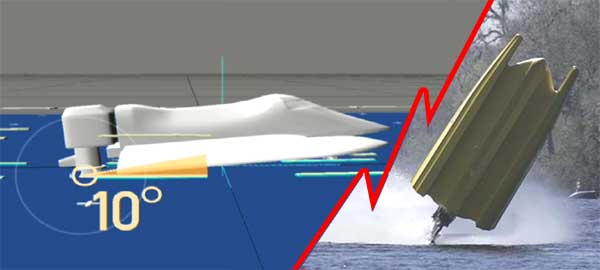 Author Jim Russell (Jimboat) is powerboat design technical consultant on a new
National Geographic special for "Thrill Zone"
series...
Author Jim Russell (Jimboat) is powerboat design technical consultant on a new
National Geographic special for "Thrill Zone"
series...
Details at: (channel.nationalgeographic.com)
check out next show date at:
Thursday, March 28, 2008 at 05A
Watch for other show dates on AR's website! aeromarineresearch.com/NatGeo_thrill-zone.html
*** "Streaming Motorsports" on Speedbox.tv - Parker ENZED Jetsprinting Championship - - Check at: speedbox.tv
*** "Champ Boat Grand Prix Series" - on SPEED Channel - Check next show at: www.champboat.com or at: www.speedtv.com
*** "F1 World Championship TV Show" on The Water Channel - Check it out at: www.waterchannel.com; [see web site for other show times]
*** NEW "War On Water" TV Show" on The Water Channel - Check it out at: www.waterchannel.com; [see web site for other show times]
*** "Class 1 – World Championship – 2006" on The Water Channel - Check it out at: www.waterchannel.com; [see web site for other show times]
*** "Offshore Classics" on The Water Channel - Check it out at: www.waterchannel.com; [see web site for other show times]
*** "American Powerboat Television" on The Water Channel - Check it out at: www.waterchannel.com; [see web site for other show times]
*** "Honda Formula 4-Stroke Powerboat Series" - Check it out at: honda-racing.co.uk
[Ed. Note: The Water Channel is available
on The Dish Network]
******************** TBPNews
*******************
9) Jimboat's Feature Articles
 NEW
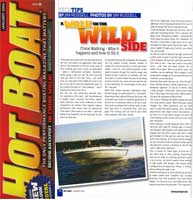
Jimboat Article Announcement! - Author Jim Russell details the secrets of Chine
Walk in performance powerboats- why it happens & how to fix it!
NEW
Jimboat Article Announcement! - Author Jim Russell details the secrets of Chine
Walk in performance powerboats- why it happens & how to fix it!
Check out full article at:
aeromarineresearch.com
Jimboat
writes Feature articles in HotBoat, Family&Performance Boating, World of
Powerboats, Extreme Boats magazines.
-
'Walk on the
Wild Side' - "Chine Walk - Why it happens & How to Fix it" - HB-Jan
2008

- 'Hump
Zone' - "Why does your Boat Porpoise?" - HB-April 2007
-
'The Bottom Line'-"Why does a Pad make a vee Hull faster?" -
F&PB-Sept 2005
- "10
Smokin' Speed Secrets Revealed..." -
HB-Feb2005
-
"Winterizing your Performance Outboard" - F&PB-Jan2005
-
"What a Drag" - 'Trim Angle & Engine Height Can Reduce Drag and
Increase Speed' - HB-Sept2004
-
"10 Safety Tips" - 'Ten Safety Ideas for High Performance Go-Fast
Boats' - HB-Aug2004
- "Flight
Path" - 'Where does Lift Come From?' - HB-April2004
- "Rocket
Science" - 'How To Increase Your Hull's Design Speed With Aerodynamics' -
World of Powerboats-Winter2004
-
"Tunnel
Vision" - 'What Factors Influence Tunnel Hull Performance' - Extreme
Boats-April2003
- "Step-by-Step"
-
'Step
Design in Powerboats' - TBPNews #88, October 2005
******************** TBPNews
*******************
See you next time!
/Jimboat
>>>>>>>>>>>>>>>>>>>>>
[Advertisement...]
MINIMOST &
MINIMAX "Sea Fleas" - In the late 50’s and early 60’s William D. Jackson
introduced the two famous seafleas known today as the Minimost and Minimax.
Plans & Full Size Patterns Now Available! Brian Cranfield at BC Seafleas
now offers full size patterns for replicas of these boats. Included in the
package is a complete set of full-sized patterns, building plans and a booklet
to help guide you through the building process. Contact Brian at:
cranfieldbrian@hotmail.com or 905-986-4868. More
details at: BC
Seafleas web page
>>>>>>>>>>>>>>>>>>>>>
>>>>>> Tunnel
Boat Performance News >>>>>>>>>>>>>>
Let us know ideas you have, requests for articles, questions or comments on TBPNews. Send
comments to TBPNews@aeromarineresearch.com
>>>>>>>>>>>>>>>>>>>>>>>>>>>>>>>>>>>>>>>>>>>>>>>>>
 Get your full, illustrated,
13th
edition copy of the world acclaimed "Secrets
of Tunnel Boat Design" book; "History
of Tunnel Boat Design" book, "Secrets
of Propeller Design" book, the "Tunnel
Boat Design" software for tunnel and high-performance vee-hull design,
and "PropWorks2"
software for speed prediction and propeller selection at the AeroMarine
Research web site: http://www.aeromarineresearch.com
Get your full, illustrated,
13th
edition copy of the world acclaimed "Secrets
of Tunnel Boat Design" book; "History
of Tunnel Boat Design" book, "Secrets
of Propeller Design" book, the "Tunnel
Boat Design" software for tunnel and high-performance vee-hull design,
and "PropWorks2"
software for speed prediction and propeller selection at the AeroMarine
Research web site: http://www.aeromarineresearch.com