|
|
|
 |
|
| Performance Boat design and setup secrets for Recreational tunnels, Offshore Cats, Racing tunnels, Fishing/Utility hulls, Vee and Vee-Pad Hulls, Bass Boats | |
| Home New About Us Free Articles Technical Articles TBPNews Archives FREE Downloads Research Contact Us | |
Testimonials What Others Say
Join
TBPNews Advertise
Links
Search Buy Now 


 |
|
| TBDP©/VBDP© Fuel Consumption Analysis | ||
| Get complete article by email request: | Share: | |
| BREAKTHROUGH! | ||
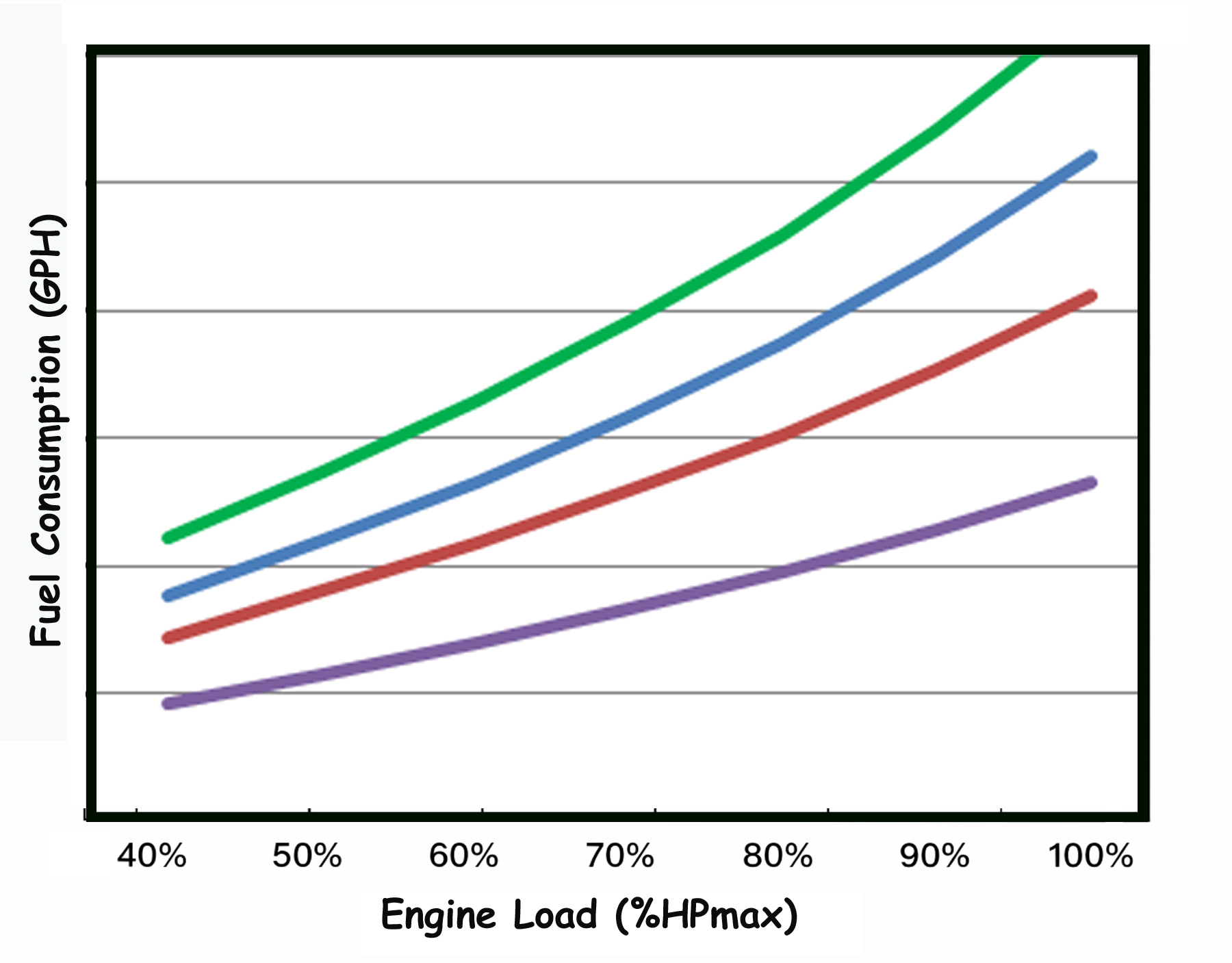 Figure 1- TBDP©/VBDP© Engine Fuel Consumption analysis provides a load-based method for predicting engine fuel flow (GPH) directly from required horsepower . Figure 2- Normalized Brake Specific Fuel Consumption (BSFC) based on Engine Fuel Consumption mappng, is based on actual calculated engine load (%HPmax), rather than simulated RPM levels, so results integrate cleanly into power prediction routines across the operating hull velocity range |
The 'Fuel Consumption Analysis' provides load-based prediction of fuel
economy based on fuel mapping curves for each engine specification. TBDP/VBDP Fuel Consumption Analysis predicts fuel use based on calculated engine loading for each operating condition, and employs individual engine fuel consumption mapping. The TBDP©/VBDP© Fuel Consumption analysis provides a load-based method for predicting engine fuel flow (GPH) directly from required horsepower, without needing RPM-fuel maps. By using a compact parametric formulation it allows accurate comparison of different engines for performance optimization. This analysis is based on actual calculated engine load (%HPmax), rather than simulated RPM levels, thus results integrate cleanly into power prediction routines, enabling rapid evaluation of range, tank sizing, operating cost, and propulsion matching across multiple configurations. The analysis presents Engine Fuel Consumption (US Gal per hour, GPH) or normalized Brake Specific Fuel Consumption (BSFC) across the operating calculated Engine Load (%HPmax) required for the hull hydrodynamic and aerodynamic loads calculated through the full velocity range. How it works
Real-World Simulation Counts Using actual hull lift/drag/power analysis results that are integrated with engine-linked individual fuel consumption mapping is the key to highly accurate fuel consumption predictions during hull design optimization. (Utilizing standard fuel consumption statistics that are not linked to real-world hull dynamics and engine loading, cannot provide valued engine management information for designers. |
|
|
More About Fuel Consumption Fuel consumption in a boat varies continuously with operating conditions. Hull resistance, speed, loading, and environment (wind and waves) determine the horsepower required, which in turn sets fuel use. Key influences include hull size and displacement, engine rating, speed/throttle setting, payload, trim and engine setup, and weather.
TBDP/VBDP analysis accounts for these factors simultaneously, recalculating required horsepower and fuel efficiency rate as conditions change, and integrating the resulting fuel consumption over the operating profile. |
||
|
Research results now included in performance analysis by TBDP©/VBDP© [more about AR's research more about AR's publications and technical articles/papers] |
||
|
©Copyright by AeroMarine Research and
Jim Russell, 1999, all rights reserved. Material from this website may not be copied or used or redistributed, in whole or in part, without the specific written consent of Jim Russell or AeroMarine Research. |
||
 about Jim Russell